


Views: 0 Author: Site Editor Publish Time: 2026-10-21 Origin: Site


Can industrial cooling reduce electricity costs without sacrificing comfort? An Evaporative Air Cooler uses water evaporation and fresh-air circulation to cool large spaces efficiently. Discover how it works, compare cooling methods, and learn how to reduce operating costs through smarter equipment selection.
An evaporative air cooler uses the natural process of water evaporation to absorb heat. Warm outdoor air passes through wet cooling pads. As water evaporates, it removes heat from the air. A fan then moves the cooled air into the working area. This process does not require the compressor-driven refrigeration cycle used by conventional air conditioners.
The main electricity demand usually comes from the fan motor and water circulation pump. Their combined consumption can be lower than the demand of a comparable compressor-based cooling system. However, the actual difference depends on equipment capacity, operating conditions, and the cooling target. Businesses should compare systems designed for similar airflow and service requirements.
Conventional air conditioning removes heat through a refrigeration cycle. It may also require outdoor condenser fans and other supporting components. These systems suit enclosed spaces that need stable temperatures and controlled humidity. However, cooling large industrial areas can increase equipment capacity and electricity demand.
An evaporative air cooler can be a practical alternative when the facility needs fresh-air cooling rather than precise temperature control. It may reduce energy consumption in suitable climates, particularly in open or semi-open workshops. Still, businesses should not assume every evaporative system consumes less energy under every condition.
Industrial evaporative cooling combines air movement and cooling. It can help remove accumulated heat, odors, and airborne contaminants when the facility has suitable exhaust ventilation. Continuous fresh-air exchange may also improve comfort around heat-generating machinery. The system works best when incoming air has a clear path through the occupied space.
Long-term costs include electricity, water, cleaning, replacement pads, and routine maintenance. A lower electricity bill may not guarantee the lowest total cost if water quality is poor or maintenance needs are high. Buyers should calculate costs using expected operating hours, local utility rates, and actual equipment specifications.
Factories, warehouses, and production workshops often contain large volumes of air. Cooling every part of these spaces with conventional air conditioning may be expensive. Evaporative air coolers can deliver high airflow and support cooling across suitable work areas. Their effectiveness depends on equipment placement and the building's ventilation design.
The fan's airflow rating alone does not guarantee uniform cooling. Machinery, partitions, storage racks, and worker locations can affect air distribution. Businesses should identify heat sources and occupied zones before deciding how many units they need.
Tip: Request rated airflow, motor power, water consumption, and operating conditions before comparing equipment efficiency.
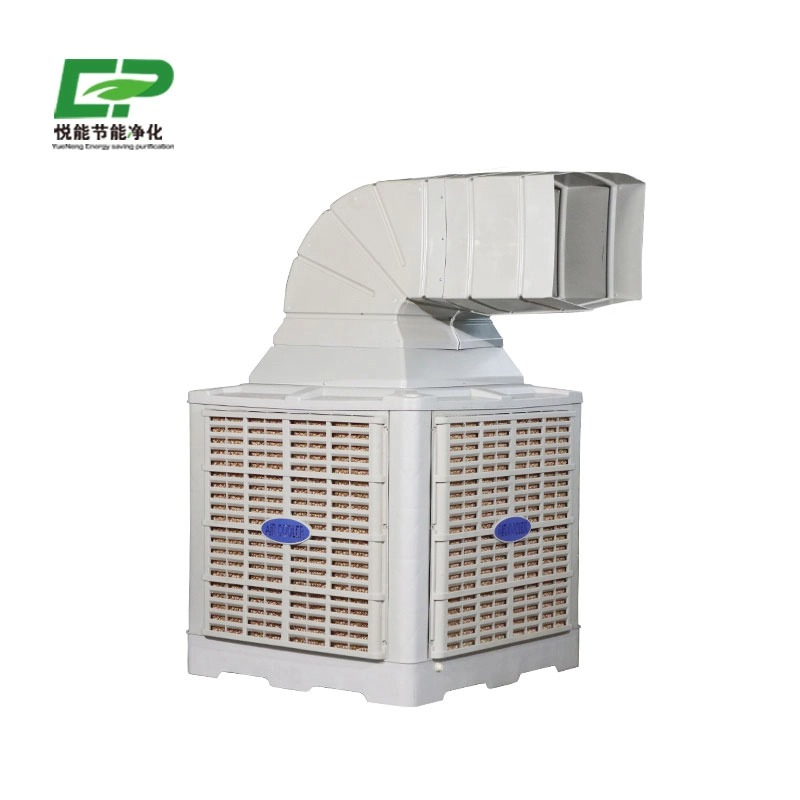
The cooling process begins when warm outdoor air enters the unit. It passes through specially designed cooling pads supplied by a water circulation system. Some water evaporates as the air moves through the wet surface. This evaporation absorbs heat and lowers the air temperature before delivery into the facility.
The resulting temperature reduction depends on outdoor temperature and relative humidity. Dry air generally allows more water to evaporate, creating a greater cooling effect. Humid air has less capacity to absorb additional moisture, so the temperature reduction becomes smaller. This physical limitation is important when planning industrial cooling.
Cooling pads provide the surface needed for evaporation. Fans draw or push air through the pads and distribute it into the workspace. A pump circulates water to keep the pads sufficiently wet during operation. These components must work together to maintain stable airflow and effective cooling.
Pad condition also matters. Mineral deposits, dust, and blocked passages can reduce airflow and evaporation efficiency. Regular inspection helps maintain cooling performance and reduces avoidable operating problems. Businesses should also check water distribution and drainage during routine maintenance.
Outdoor temperature, relative humidity, and local airflow determine how effectively an evaporative air cooler operates. Hot, dry weather usually offers favorable conditions. Hot, humid weather limits evaporation and may produce less noticeable cooling. Indoor heat loads and exhaust capacity also influence the final result.
Unlike a sealed refrigeration system, evaporative cooling introduces outdoor air and adds moisture. Therefore, it is not suitable for every production environment. Facilities handling moisture-sensitive materials or requiring strict humidity control should assess alternative systems or a hybrid design.
The primary difference is how each system removes heat. An evaporative air cooler relies on water evaporation and fan-driven airflow. Traditional air conditioning uses a refrigeration cycle to transfer heat from indoor air to the outdoors. The latter can provide more precise temperature control, but its compressors generally require substantial electrical power.
Evaporative cooling can reduce energy demand when outdoor conditions support effective evaporation. It also suits facilities that benefit from continuous fresh-air exchange. Conventional air conditioning remains useful when humidity control, low indoor temperatures, or enclosed environmental conditions are essential.
Comparison factor | Evaporative air cooler | Conventional air conditioning |
|---|---|---|
Cooling method | Water evaporation | Refrigeration cycle |
Main power demand | Fans and water pumps | Compressors, fans, and controls |
Fresh-air delivery | Common in direct systems | Depends on system design |
Humidity effect | Adds moisture to supply air | Often removes indoor moisture |
Suitable conditions | Hot, relatively dry environments | Wider range of climates |
Best-fit applications | Ventilated industrial spaces | Enclosed, temperature-controlled areas |
An evaporative air cooler may have a simpler cooling mechanism than a compressor-based system. However, installation costs still depend on unit capacity, electrical connections, water supply, exhaust openings, and mounting arrangements. Window-mounted and portable units may suit certain facilities, while larger workshops may require multiple units and planned air distribution.
Climate is equally important. In dry regions, evaporative cooling can provide useful temperature reductions with relatively low electrical demand. In humid regions, its cooling potential decreases. Businesses should evaluate local weather data and indoor humidity limits before investing.
Tip: Neither system is universally more efficient. Compare equivalent cooling needs, local climate, installation costs, and annual operating expenses.
Manufacturing facilities often generate heat through machinery, production lines, motors, and industrial processes. An evaporative air cooler can deliver fresh air to occupied areas and help reduce heat discomfort. It may be especially useful in workshops that have high ceilings, large doors, or substantial ventilation requirements.
Equipment placement should reflect where workers spend time and where heat accumulates. A single high-capacity unit may not cool every work zone evenly. Multiple units or carefully directed airflow may provide better coverage. Businesses should also confirm whether the production process tolerates additional humidity.
Warehouses can accumulate heat beneath roofs and around storage areas. Loading doors, forklifts, lighting, and densely packed goods may affect indoor conditions. Evaporative air coolers can support ventilation and improve airflow in suitable buildings. Their effectiveness depends on the warehouse layout and available exhaust paths.
A window-mounted model may suit facilities with suitable external openings. For larger areas, businesses may evaluate higher-airflow equipment. For example, Yueneng offers a 22,000 m³/h, 2.2 kW industrial evaporative air cooler designed for window mounting. Buyers should verify the unit's specifications and confirm its suitability for the intended installation.
Greenhouses and livestock buildings often need both temperature management and air exchange. Evaporative cooling can support these goals when outdoor conditions are suitable. However, excess humidity may affect plant health, animal comfort, or disease management. Operators must balance cooling performance against ventilation and moisture requirements.
Aquaculture and agricultural facilities also have specific environmental needs. Cooling equipment should match the building's airflow pattern, humidity limits, and operational schedule. A site assessment helps determine whether direct evaporative cooling can meet these requirements.
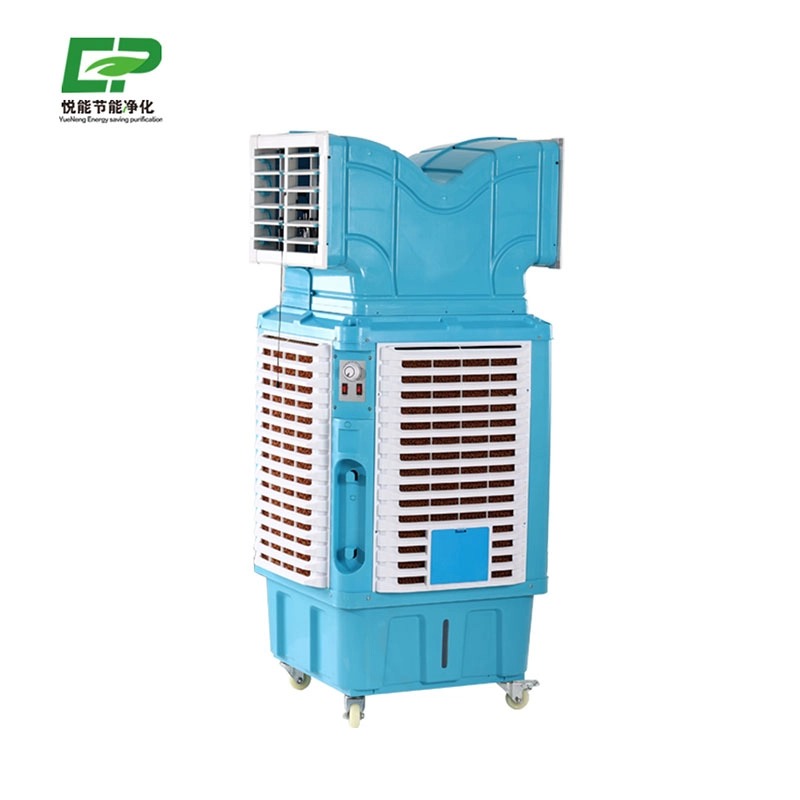
Start by measuring the facility's floor area, ceiling height, and total indoor volume. Identify machinery, production processes, and other heat sources. Record worker numbers and operating hours. These details help determine the required airflow and cooling coverage.
Next, assess existing ventilation and exhaust capacity. Fresh air entering a building needs a suitable route out. Without adequate exhaust, pressure can build up, reducing effective airflow and allowing heat to remain trapped. Equipment selection should therefore consider the complete ventilation system rather than cooling capacity alone.
Cooling pads affect evaporation performance, while fans determine the volume and movement of air. Buyers should compare rated airflow, motor power, pad design, and expected operating conditions. They should also check whether the unit supports the required mounting arrangement and air distribution pattern.
Single-sided and double-sided ventilation configurations may suit different installation layouts. However, neither configuration guarantees better performance in every building. The correct choice depends on available space, intake direction, exhaust openings, and the locations requiring cooling.
Position air coolers to deliver fresh air toward occupied areas and major heat sources. Provide clear exhaust routes on the opposite side whenever the building layout allows. This arrangement helps air travel through the workspace instead of leaving immediately after entering.
Avoid placing equipment where walls, storage racks, or machinery block the airflow. Review seasonal wind direction and existing openings during planning. A practical airflow assessment can reveal stagnant areas before installation.
An undersized system may fail to deliver enough airflow during peak heat. An oversized system may increase capital costs and consume more power than necessary. Buyers should balance rated airflow, operating power, cooling requirements, and the expected number of operating hours.
For reference, Yueneng offers a 3 kW, 380 V industrial evaporative air cooler rated at 30,000 m³/h. These figures provide a starting point for equipment comparison, not a guarantee of site performance. Actual cooling results depend on installation, climate, and airflow resistance.
Tip: Ask suppliers to explain rated airflow, electrical input, water demand, and installation requirements using consistent test conditions.
Electricity costs depend on motor power, pump demand, operating schedules, and local electricity rates. Businesses can estimate fan and pump consumption using equipment power ratings and expected running hours. Actual consumption should be verified through manufacturer data or electrical measurements.
For example, a unit drawing 2.2 kW and running for 10 hours consumes 22 kWh under those assumed conditions. This is a calculation based on rated input, not a measured result. Actual consumption may differ because of operating settings and system conditions. Multiply the expected consumption by the local electricity rate to estimate daily energy costs.
Water costs depend on evaporation, system operation, drainage, and water management. Some water may also be lost through cleaning or periodic flushing. Local water quality affects maintenance needs because mineral deposits can accumulate on pads and internal components.
Inspect pads, pumps, filters, and water distribution lines regularly. Clean components according to the manufacturer's instructions. Poor maintenance can reduce airflow, weaken cooling performance, and increase operating costs. Businesses should include water treatment and replacement parts in annual budgets where applicable.
Direct evaporative cooling adds moisture to incoming air. This can be useful in dry conditions, but it may create problems in moisture-sensitive production areas. Excess humidity can affect materials, product quality, storage conditions, and worker comfort. Facilities must evaluate these risks before installation.
Ventilation also affects indoor air quality. An effective system needs sufficient fresh-air supply and an appropriate exhaust route. Where dust, fumes, or chemical vapors are present, additional extraction and filtration may be necessary. An evaporative air cooler should not replace dedicated industrial exhaust or safety systems.
The purchase price represents only one part of the investment. Businesses should also consider installation, electrical work, water connections, maintenance, cleaning, and expected service life. Compare these costs against the existing system's energy consumption and operating requirements.
A useful evaluation covers annual electricity costs, water expenses, scheduled maintenance, and any required replacement components. It should also consider whether the new system can meet production needs during the hottest periods. A cheaper unit may provide poor value if it cannot deliver the required airflow.
Collect energy bills or equipment-level measurements from the current cooling system. Then estimate the proposed system's electrical consumption using rated power and realistic operating hours. Compare both systems over the same operating period and under similar cooling requirements.
For example, if the existing system consumes 100 kWh per operating day and the proposed equipment is expected to consume 30 kWh, the estimated difference is 70 kWh per day. These figures are illustrative only and require verification using actual site data. Water costs, installation expenses, and maintenance must also enter the final calculation.
Facilities with large open spaces, high ventilation requirements, and hot, dry outdoor conditions may benefit most. Workshops, warehouses, and certain agricultural buildings are common candidates. Sites currently using compressor-based cooling across large, frequently opened spaces may also merit an assessment.
However, facilities requiring precise temperature and humidity control may need conventional air conditioning or a hybrid solution. Businesses should confirm technical suitability before estimating payback. A site-specific assessment provides a more reliable investment decision than a general energy-saving percentage.
Nantong Yueneng Energy Saving Purification Equipment Co., Ltd. provides industrial evaporative air coolers for energy-efficient cooling and ventilation. Its solutions help factories and warehouses manage heat while reducing electricity demand in suitable climates. With over 16 years of industry experience, Yueneng supports businesses in selecting cooling equipment for their operational needs.
A: An Evaporative Air Cooler uses water evaporation and fans, reducing reliance on energy-intensive compressors.
A: Yes, it suits well-ventilated workshops and warehouses, especially in hot, dry climates.
A: Efficient airflow, proper sizing, and regular maintenance help control electricity and water consumption.
A: Its cooling performance decreases as humidity rises, making dry climates more suitable.
A: Compare electricity, water, installation, and maintenance expenses using actual operating data.


