


Views: 0 Author: Site Editor Publish Time: 2026-10-21 Origin: Site


Why does poor air circulation increase heat and reduce workplace comfort? An Exhaust Fan helps remove stale air, excess heat, and moisture from industrial facilities. This guide explains fan selection, airflow planning, installation, and maintenance to improve ventilation efficiency and control operating costs.

An Exhaust Fan improves industrial air circulation by removing indoor air and encouraging replacement air to enter the building. This process helps prevent hot, humid, or stale air from remaining trapped around machinery and workstations. In many factories, heat comes from production equipment, motors, lighting, and manufacturing processes. Without sufficient ventilation, these heat sources can raise indoor temperatures throughout the working day. An exhaust system provides a practical way to move this unwanted air outside.
Most wall-mounted industrial exhaust fans operate through mechanical airflow. When the fan runs, it draws indoor air toward the outlet and discharges it outdoors. This creates a pressure difference that encourages fresh air to enter through designed inlets, windows, louvers, or other openings. The resulting airflow helps remove accumulated heat and moisture. It can also reduce odors and dilute certain airborne contaminants when the ventilation design provides adequate air exchange. However, an exhaust fan does not automatically remove every pollutant. Dust, chemical vapors, and hazardous fumes may require dedicated extraction equipment.
Effective circulation depends on the complete airflow path. Fresh air should enter where it can travel through occupied areas before reaching the exhaust outlet. If the inlet sits too close to the fan, air may leave the building without ventilating important work zones. This problem is known as short-circuiting. Poorly placed equipment can therefore create hot spots even when the fan has a high rated airflow.
Businesses should map heat sources, worker positions, and existing openings before choosing a system. They should also consider seasonal conditions and the amount of replacement air required. A coordinated design helps the fan remove unwanted air while supporting stable ventilation across the facility.
Tip: Keep air inlets and exhaust outlets positioned to promote airflow through the occupied space, not directly between openings.
Industrial ventilation must manage more than temperature. Production processes can release moisture, odors, and airborne particles. Warehouses may experience heat buildup beneath roofs, while manufacturing areas may contain several concentrated heat sources. An Exhaust Fan helps move indoor air outdoors, reducing the accumulation of these unwanted conditions when correctly sized and installed.
Moisture control is especially important in agricultural buildings, greenhouses, and facilities operating in humid climates. Excess moisture can contribute to condensation, corrosion, and uncomfortable working conditions. In some settings, it may also affect stored materials or production quality. Mechanical exhaust helps remove humid air and supports replacement air movement. Its effectiveness depends on outdoor humidity, moisture generation, and the available supply of fresh air.
Air quality requires a more specific assessment. General ventilation can dilute some airborne contaminants, but it should not replace local exhaust ventilation where pollutants are generated at a specific point. Welding fumes, chemical vapors, and combustible dust may require engineered extraction, filtration, or other protective measures. Businesses must assess the hazards before deciding whether a general industrial fan is suitable.
The fan's construction also matters in demanding environments. Moisture, corrosive gases, and chemical exposure may damage unsuitable materials over time. For these locations, buyers should assess casing material, blade material, motor protection, and maintenance access. Yueneng offers a 1460 mm, 50-inch FRP industrial exhaust fan designed for large spaces and demanding environments. Its FRP construction offers corrosion resistance, while its stated airflow capacity reaches 44,000 m³/h. Buyers should confirm actual performance under their installation conditions.
Note: General ventilation may dilute contaminants, but hazardous processes can require dedicated extraction and professional safety assessment.
Airflow capacity is one of the first specifications buyers should evaluate. It indicates how much air a fan can move under stated test conditions. However, a high rated airflow does not guarantee the same volume after installation. Louvers, guards, ducts, building openings, and other restrictions can increase resistance and reduce delivered airflow.
Businesses should begin by estimating the room volume and required air changes. The air changes per hour (ACH) value describes how many room volumes pass through the ventilation system each hour. A preliminary airflow estimate can be calculated by multiplying room volume by the target ACH. For example, a 3,000 m³ workshop requiring six air changes per hour would need approximately 18,000 m³/h of ventilation airflow. This is an illustrative calculation, not a universal recommendation. The correct target depends on heat loads, occupancy, pollutants, and applicable ventilation standards.
Fan type is another important consideration. Axial exhaust fans move large air volumes along the fan's axis and are common in wall-mounted industrial applications. Their suitability depends on the required airflow and system resistance. Other fan designs may be more appropriate for ducted systems or applications requiring higher static pressure. Buyers should evaluate the complete operating point rather than comparing maximum airflow figures alone.
Installation dimensions must also match the building. The fan opening, frame, shutters, and mounting structure should fit securely. An undersized opening can restrict airflow, while poor sealing can allow unwanted air leakage. Protective components should suit the environment and comply with relevant safety requirements.
Yueneng's Exhaust Fan product range includes industrial ventilation options for workshops, greenhouses, and farms. Buyers can compare fan types and capacities against their facility requirements. A supplier should also confirm rated power, voltage, frequency, noise, mounting method, and performance under expected operating resistance.
Material selection affects fan durability, maintenance requirements, and long-term operating costs. Industrial fans may use galvanized steel, stainless steel, or fiberglass-reinforced plastic. Each material offers different benefits, so buyers should match the construction to the environment rather than selecting by price alone.
Galvanized steel is commonly used for general industrial ventilation. Its protective coating helps resist corrosion under suitable conditions, and it can offer a practical balance of cost and strength. However, aggressive chemicals or persistent moisture may damage the coating. Stainless steel may be preferable where cleaning, hygiene, or stronger corrosion resistance is important. The appropriate grade depends on the chemicals and operating conditions involved.
Fiberglass-reinforced plastic, or FRP, can offer strong resistance to moisture and many corrosive environments. It may be useful in certain chemical-processing areas, humid facilities, and agricultural buildings. Yet buyers should still confirm chemical compatibility, temperature limits, structural requirements, and maintenance instructions. No material should be treated as universally resistant to every industrial substance.
Blade and motor specifications deserve equal attention. Blade material influences strength, corrosion resistance, and operating stability. Motor protection should suit dust, moisture, temperature, and electrical conditions at the installation site. Buyers should also review motor efficiency, access for servicing, and availability of replacement components.
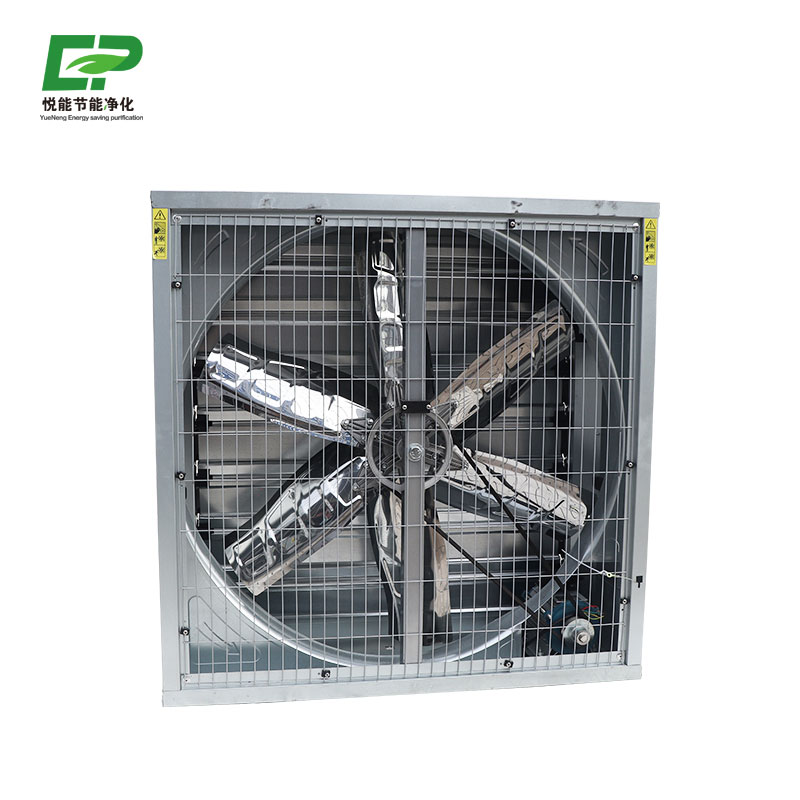
For agricultural and workshop applications, Yueneng also offers a 1380 mm heavy-hammer industrial exhaust fan. This type uses a weighted shutter mechanism designed to open during operation and close when the fan stops. The exact material and specifications should be checked against the selected model. Comparing construction, airflow, and maintenance access helps businesses select equipment that suits their operating environment.
Tip: Match casing and blade materials to actual chemical exposure, humidity, cleaning methods, and expected service life.
Factories often generate heat through machinery, production lines, welding, and other industrial processes. An effective Exhaust Fan system helps remove accumulated hot air and supports the movement of replacement air. However, the correct arrangement depends on where heat is produced and how the building is used. A workshop with distributed heat sources may need a different layout from a facility with one concentrated process.
Start by identifying the hottest work zones and the locations where workers spend the most time. Determine whether heat rises toward the roof or collects near particular machines. Then plan exhaust locations to remove unwanted air without allowing it to pass through occupied areas unnecessarily. Fresh-air inlets should provide a clear path toward the exhaust fans.
Large facilities may need multiple fans to cover separate zones. However, adding more units without checking the airflow path can increase energy consumption without solving circulation problems. Engineers should assess the combined airflow, building pressure, and available replacement air. They should also consider whether doors, windows, or other openings will remain available during operation.
Noise and maintenance access matter as well. Fans installed near workstations may require additional noise assessment. Equipment should remain accessible for cleaning, inspection, and repairs. Guards and electrical connections must meet the relevant safety requirements.
For large workshops, a fan with suitable corrosion resistance and high airflow may provide a practical option. The final choice should reflect the facility's heat load, air exchange needs, and installation limits. Businesses should avoid selecting equipment based solely on room area or the largest available fan size. A ventilation assessment helps determine the number, location, and capacity of units required for reliable performance.
Warehouses and agricultural buildings have different ventilation priorities. Warehouses may accumulate heat beneath roofs and around stored goods. Loading doors, storage racks, and internal partitions can influence air movement. An Exhaust Fan system should therefore support circulation across the areas requiring ventilation, rather than simply removing air near one wall.
Greenhouses need careful temperature and humidity management. Excessive heat can stress crops, while poor ventilation may allow moisture to accumulate. Exhaust fans can remove warm indoor air and draw replacement air through suitable inlets. Their effectiveness depends on outdoor conditions, greenhouse design, crop requirements, and the availability of a balanced air supply.
Livestock buildings have additional needs. Ventilation must remove moisture, odors, and animal-generated heat while providing suitable air movement. Seasonal changes may require different operating strategies. Cold-weather ventilation must control moisture and contaminants without creating harmful drafts or excessive heat loss. Fan control should therefore reflect animal needs and building conditions.
For poultry farms and similar facilities, heavy-hammer exhaust fans are one option to consider. Yueneng's 40-inch, 1100 mm galvanized industrial exhaust fan is designed for industrial and agricultural ventilation applications. Its listed airflow capacity is 32,000 m³/h, although actual delivered airflow depends on installation resistance and operating conditions.
Before purchasing, confirm the required air exchange, mounting dimensions, environmental exposure, and maintenance needs. Agricultural operators should also check whether automated controls can adjust fan operation as temperatures and humidity change. Matching equipment to the specific building helps maintain better environmental control while avoiding unnecessary energy use.
Note: Greenhouses, livestock buildings, and warehouses have different ventilation targets. Select equipment using application-specific requirements rather than one general airflow rule.
An Exhaust Fan performs best when the entire ventilation system is designed around its operating requirements. Even a well-built fan may deliver poor results if replacement air cannot enter freely. Restricted inlets, blocked louvers, and poorly arranged openings can increase system resistance. The fan may then move less air than expected while continuing to consume electricity.
Begin by inspecting the available air inlets and exhaust paths. Ensure openings are large enough for the intended airflow and remain clear during operation. Where possible, direct incoming air through the occupied zone before it reaches the exhaust outlet. This reduces the risk of short-circuiting and helps improve ventilation where it matters most.
Next, verify the fan's operating point. Rated airflow and power should be reviewed alongside the system's resistance. If ducts, screens, or protective components create significant pressure losses, the selected fan may not achieve its expected airflow. A qualified ventilation professional can assess these factors and recommend suitable adjustments.
Variable-speed controls may help reduce energy use where ventilation demand changes throughout the day. However, speed control must be compatible with the motor and fan design. Minimum ventilation requirements must also remain satisfied when operating speed decreases. In facilities with heat-sensitive processes or livestock, controls should respond to appropriate temperature, humidity, or air-quality measurements.
Regular monitoring provides another useful tool. Measure power consumption and, where practical, verify airflow at commissioning. Record the baseline so future inspections can identify changes. Reduced airflow may indicate blocked openings, dirty blades, shutter problems, or motor wear. Correcting these issues early helps maintain ventilation performance without unnecessary equipment replacement.
Tip: Commission the system under real operating conditions and record airflow, power use, and control settings for future comparison.
Routine maintenance helps preserve airflow, control operating costs, and reduce unexpected downtime. Dust can accumulate on blades and guards, while corrosion may weaken exposed components. Shutters can also become obstructed or fail to close properly. These problems may reduce ventilation effectiveness and place additional strain on the system.
Create an inspection schedule based on operating hours and environmental conditions. Facilities with high dust levels or corrosive air may need more frequent checks than clean warehouses. During inspections, review blade condition, mounting bolts, guards, shutters, motor operation, electrical connections, and unusual vibration. Isolate electrical power before carrying out maintenance, and follow the manufacturer's safety procedures.
Lubrication requirements depend on the fan and motor design. Some direct-drive units have fewer belt-related maintenance tasks than belt-driven systems, but they still require regular inspection. Belt-driven models need suitable belt tension and alignment checks. In all cases, follow the equipment manual rather than applying a single maintenance routine to every fan.
Operating records can reveal developing problems. Track energy consumption, maintenance costs, repair frequency, and observed airflow. A sudden increase in power use or a noticeable decline in air movement may signal a fault. Timely investigation can prevent a small problem from becoming a costly production interruption.
Businesses should also plan for spare parts and service support. Check replacement availability for motors, shutters, blades, and other critical components. When comparing suppliers, consider warranty terms and technical assistance alongside purchase price. A reliable support arrangement can simplify maintenance planning and reduce downtime over the equipment's service life.
Finally, review the system whenever the facility changes. New machinery, partitions, storage arrangements, or production schedules can alter ventilation requirements. Reassessing the system after major changes helps ensure the installed fan capacity remains suitable.
Tip: Keep inspection records and investigate unusual noise, vibration, reduced airflow, or rising electricity use promptly.
Nantong Yueneng Energy Saving Purification Equipment Co., Ltd. provides industrial Exhaust Fan solutions for factories, warehouses, and agricultural facilities. Its FRP and galvanized models support effective ventilation, heat removal, and reliable operation. Proper selection and maintenance help businesses improve air circulation and manage long-term operating costs.
A: An Exhaust Fan removes hot, humid air and encourages fresh air intake.
A: Consider airflow capacity, room size, fan materials, and ventilation requirements.
A: Position them to remove stale air while allowing fresh air to cross occupied areas.
A: Yes, proper ventilation helps remove accumulated heat and improve workplace comfort.
A: Clean blades, inspect shutters, check motor operation, and address unusual vibration promptly.


