


Views: 0 Author: Site Editor Publish Time: 2026-10-16 Origin: Site


Do you view evaporative cooling pad degradation as an unavoidable operational expense? You should reframe this mindset immediately. Premature media failure is rarely a material defect. Instead, it acts as a direct symptom of unmanaged water chemistry and flawed maintenance protocols.
Facility managers often blame the pad material for premature failure. However, the root cause usually hides in the water supply. High total dissolved solids (TDS), improper pH levels, or unchecked biological fouling cause catastrophic system damage. When operators ignore these metrics, mineral scaling and biofilm inevitably choke the system.
Proactive water quality management remains the most cost-effective lever for extending pad life. Controlling water chemistry helps you maintain optimal static pressure and reduce systemic energy costs. In this guide, you will learn how specific water parameters dictate media longevity. We will also explore how to build a resilient, chemistry-focused operational protocol.
Water quality directly impacts your facility's bottom line. Many operators treat water as a passive resource. This oversight turns pad degradation into a compounding financial drain. Every millimeter of scale buildup translates to measurable financial losses. You must view cooling media not as a static consumable, but as a dynamic component dependent on fluid chemistry.
Mineral scaling physically restricts airflow through the cooling media. As scale accumulates inside the flutes, it reduces the available space for air to pass. This blockage increases the system's static pressure. Fan motors must overcome this added resistance to maintain target cooling temperatures. Because of the fan affinity laws, even a small increase in static pressure forces exponential increases in energy consumption. Your electrical expenses will surge well before you visually notice a heavily scaled pad.
A properly maintained cooling pad typically boasts a baseline lifespan of three to five years. Excellent water management can sometimes extend this further. In stark contrast, subjecting pads to untreated hard water accelerates physical destruction. Media in these harsh environments often fails in just one or two seasons. Replacing pads prematurely requires significant capital outlays. It also demands costly maintenance labor and causes disruptive facility downtime.
Poor water quality damages more than just the cellulose media. As mineral scale thickens, chunks frequently flake off into the water stream. These abrasive fragments travel through the system. They foul distribution headers, damage pump impellers, and clog return lines. Furthermore, excessive biological growth creates thick biofilms. Sludge can migrate into downstream HVAC components, compromising the entire climate control architecture.
| Metric | Optimal Range | Primary Risk if Unmanaged |
|---|---|---|
| pH Level | 6.0 - 8.0 | Resin dissolution (low pH) or rapid scaling (high pH). |
| Calcium Hardness | < 50 ppm (makeup) | Severe flute blockage and increased static pressure. |
| Alkalinity | < 100 ppm | Accelerates calcium carbonate precipitation. |
| Biologicals (Algae) | Zero visible growth | Surface blinding, reduced evaporation, and poor air quality. |
Understanding the exact mechanisms behind media degradation helps you prevent it. Pure water evaporates, but everything dissolved in it remains behind. This fundamental thermodynamic reality means your sump water grows continuously more concentrated. If you do not monitor specific metrics, your system will quickly destroy its own cooling media.
Evaporation acts as a massive distillation process. Water leaves the system as a pure vapor. Meanwhile, minerals like calcium carbonate and silica stay in the sump. We measure these remaining particles as Total Dissolved Solids (TDS). As water recirculates, the TDS concentration increases. We call this process "concentration cycles." High concentration cycles dictate the speed of scaling. Once calcium carbonate reaches its solubility limit, it crashes out of solution. It then forms a cement-like layer over your media.
Cellulose cooling pads rely on specialized cross-linking resins for structural integrity. These resins act as the glue holding the paper together. The operational pH range for your water should strictly remain between 6.0 and 8.0.
Highly alkaline water (pH above 8.0) acts as a catalyst for mineral scaling. It drastically lowers the solubility of calcium. Conversely, acidic water (pH below 6.0) attacks the pad chemically. Acidic conditions dissolve the structural resins. Once the resin breaks down, the cellulose media softens. It eventually sags, collapses, and blocks airflow completely.
Cooling pads provide a perfect environment for biological growth. They offer continuous moisture, nutrient-rich dust from incoming air, and exposure to sunlight. This combination encourages aggressive algae and bacterial proliferation. Biofilm creates a slimy layer that completely blinds the pad surface. This blinding prevents water from contacting the air, ruining cooling efficiency. Unmanaged biological growth also introduces severe air quality risks. Facilities must manage this carefully to maintain compliance and protect occupant health.
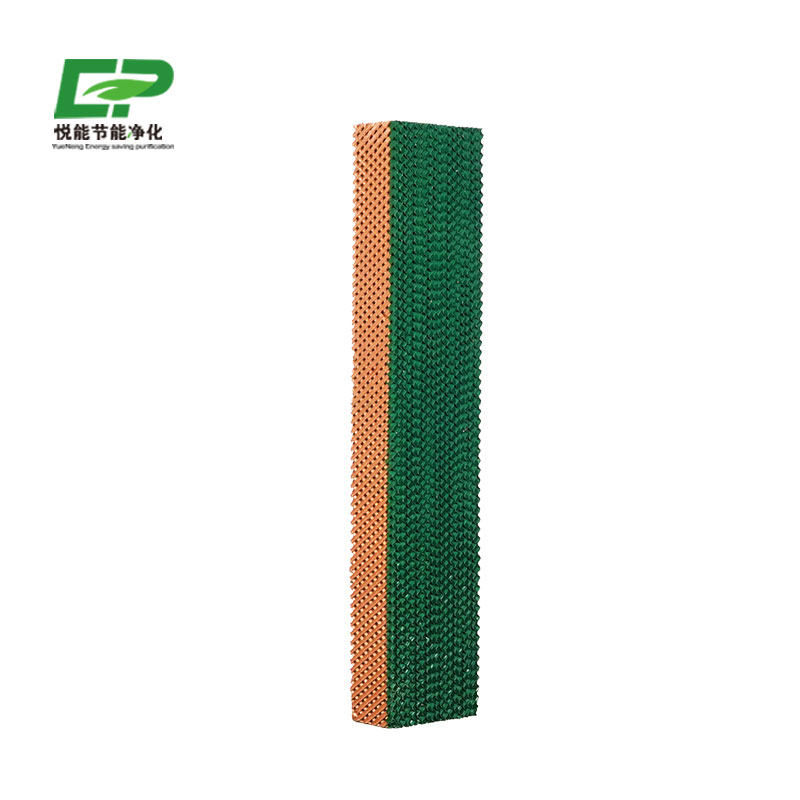
Not all cooling media reacts to water quality in the exact same way. Geometry plays a massive role in how scale accumulates. We must evaluate the widely used 7090 cooling pad to understand these dynamics. This specific model features unique unequal flute angles of 70 degrees and 90 degrees.
The 7090 geometry excels at maximizing air-water contact time. Air must navigate a complex, winding path through the flutes. This friction creates superior cooling efficiency. However, this exact high-evaporation design introduces vulnerabilities. Because it evaporates water so rapidly, it leaves behind minerals at an accelerated rate. The 7090 model becomes highly sensitive to mineral buildup if your water quality remains poor.
Scale does not form uniformly across the media. It typically attacks the air-entering edge of the 7090 pad first. This edge experiences the highest evaporation rate due to direct contact with hot, dry incoming air. As scale builds here, it acts as a physical dam. It disrupts the uniform water film required for proper operation.
This disruption creates dry streaks downstream in the pad matrix. Hot air travels through these dry patches without evaporating any water. Uncooled air then bypasses into your facility, destroying temperature stability. You lose cooling capacity precisely when you need it most.
You cannot rely on simple visual inspections to protect your system. A reactive approach guarantees premature failure. Implementing a strict, evidence-based evaporative cooling pad maintenance protocol requires discipline. This framework moves operations from guessing to controlling.
Algae and bacteria require constant moisture to survive. You can eliminate them without harsh chemicals by implementing a daily dry-out cycle. Turn off the water pumps while allowing the system fans to continue running. Do this for one to two hours every single day. The moving air completely dries the cellulose matrix. This daily desiccation starves algae and bacterial biofilm. It stands as your primary, chemical-free defense against organic fouling.
You must prevent sump water from over-concentrating. Calculate your required bleed-off rates based on your makeup water hardness. A reliable automated blowdown system continuously discharges a portion of the concentrated sump water. It replaces it with fresh makeup water.
Avoid the common operational error of closing bleed valves to "save water." Shutting off the bleed system guarantees catastrophic scaling. The resulting equipment damage and energy waste will cost far more than the water you supposedly saved.
When scale does form, you must follow strict cleaning limitations. Never use aggressive chemicals like sulfuric acid. Harsh acids quickly destroy the stiffening agents inside the cellulose. Once you dissolve the resin, you ruin the pad permanently.
Instead, use soft bristle brushes to gently remove loose surface debris. If chemical descaling becomes necessary, only deploy approved, mild descaling agents. Ensure any chemical you use explicitly states compatibility with cellulose materials. Rinse the system thoroughly immediately after cleaning.
You have several options to correct poor water chemistry. Choosing the right path requires comparing capital expenditure (CapEx) against ongoing operational expenditure (OpEx). You must balance the upfront costs of equipment with the recurring costs of chemicals and maintenance labor.
Investing in water softeners (ion exchange) removes calcium and magnesium before they enter your sump. Softeners replace these hard minerals with highly soluble sodium. This virtually eliminates scale formation.
Some facilities consider reverse osmosis (RO) for ultimate water purity. However, RO systems require massive upfront capital. They also reject large volumes of wastewater. RO is often too expensive and inefficient for high-volume agricultural or warehouse cooling applications. Standard ion exchange softening usually offers a much better balance of cost and performance.
If mechanical softening is unfeasible, consider chemical scale inhibitors. Polyphosphates bind to calcium molecules, keeping them suspended in the water. This prevents them from precipitating onto the pad surface.
When evaluating chemical solutions, demand absolute transparency from vendors. You must confirm chemical compatibility with cellulose resins. Many standard industrial water treatments contain aggressive solvents that will dissolve your media. Always verify product safety data sheets before introducing new chemicals to your sump.
Do not buy replacement pads until you understand your water. You must conduct a baseline water test first. Measure TDS, pH, and calcium hardness. Treat this test as a mandatory prerequisite. Once you understand your baseline chemistry, you can select the appropriate treatment strategy. Fixing the water ensures your next set of cooling media actually reaches its designed lifespan.
A cooling pad is only as effective as the water running through it. High-efficiency media like the 7090 model requires matching diligence in water chemistry. If you ignore water quality, you guarantee premature structural failure and soaring energy bills. Operators must shift their focus from reactionary replacements to proactive chemical management.
To optimize your facility operations immediately, take these specific actions:
Stop perpetually budgeting for premature pad replacements. Control your water, and you will control your cooling costs.
A: You should conduct a comprehensive water test at the beginning of every cooling season. This establishes your baseline. During peak usage months, perform simple TDS and pH testing at least once a month. Monthly testing helps you verify that your automated blowdown system is functioning correctly.
A: No, you should avoid using household bleach. Heavy chlorine concentrations attack the structural integrity of cellulose pads. Bleach dissolves the protective resins, causing rapid physical deterioration and sagging. Rely on daily dry-out cycles and approved, mild algaecides specifically formulated for cellulose media instead.
A: An acceptable ratio typically keeps sump water TDS under three to four times the makeup water TDS. The exact limit depends entirely on your baseline calcium hardness. If your makeup water is extremely hard, you may need to keep cycles closer to two. Always automate this process.


