


Views: 0 Author: Site Editor Publish Time: 2026-10-01 Origin: Site


Evaporative cooling presents a unique engineering challenge. You must balance maximum temperature drops against the physical energy required to pull air through restrictive wet media. Over-specifying pad thickness dramatically spikes system static pressure. This strains your exhaust fans and reduces overall airflow volume. Under-specifying pad thickness leaves your facility far too hot during peak summer months. Furthermore, exceeding optimal air velocity limits causes water carry-over. This phenomenon ruins sensitive downstream equipment and rapidly degrades pad lifespan.
This comprehensive guide provides facility managers and system engineers with a clear, physics-based framework. You will learn how to select the precise evaporative media configuration for your needs. We examine how to match specific airflow demands directly to local climate realities. By understanding the aerodynamic properties of these systems, you can achieve superior environmental control without compromising infrastructure integrity.
Evaporative cooling is never a one-size-fits-all solution. Mismatching a 7090 evaporative cooling pad to your facility's exhaust fans creates immediate systemic inefficiencies. Every exhaust fan operates on a specific performance curve. When you force fans to pull air through excessively restrictive media, they move significantly less air. This drop in cubic feet per minute (CFM) completely negates the benefits of a thicker cooling pad. You end up with a warmer building despite having a larger cooling surface.
You must approach common manufacturer claims with a highly skeptical lens. Many sales brochures promise "maximum cooling" without mentioning the environmental constraints. Cooling efficiency remains strictly bound by your local ambient wet-bulb temperature. The psychrometric chart governs this thermodynamic process, not proprietary magic. You cannot physically cool air below its wet-bulb temperature using standard evaporation. Therefore, buying the thickest pad available often results in zero additional cooling if your climate restricts evaporation potential.
We define a successful installation using three strict criteria. First, it must achieve your target temperature reduction. Second, it must operate at the lowest acceptable static pressure. Third, the system must not require premature fan motor replacements due to constant overexertion. Achieving this balance requires precise mathematical alignment between your fan capacity, pad surface area, and flute geometry.
Common Mistake: Relying solely on dry-bulb temperatures when selecting pad thickness. You must evaluate the wet-bulb depression to understand your true evaporation potential.
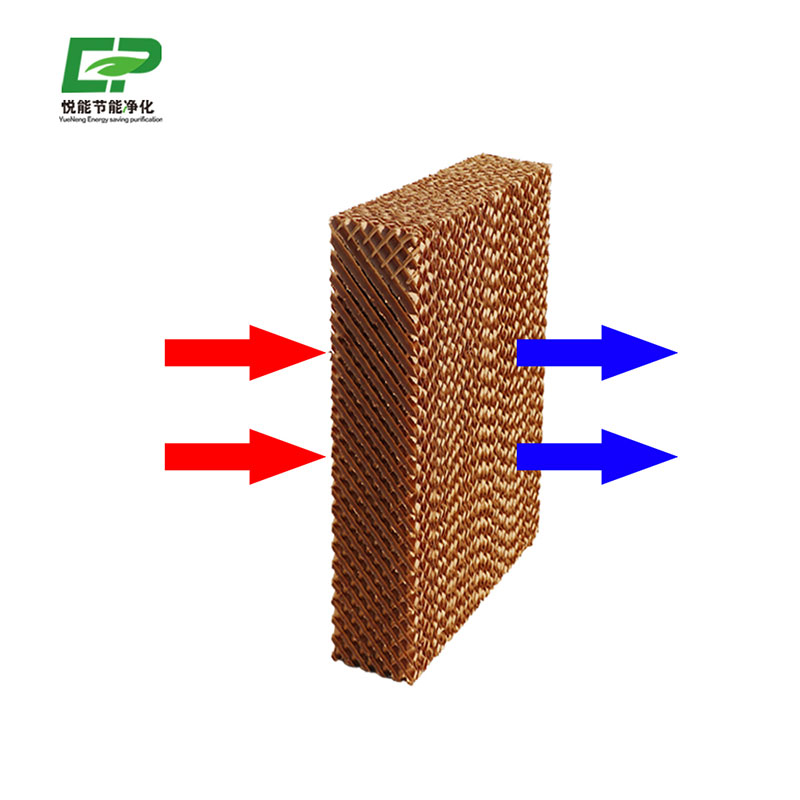
Selecting the correct thickness determines both your cooling ceiling and your airflow floor. Each thickness profile serves a specific operational scenario. You must evaluate your local climate and existing fan hardware before deciding.
These thinner pads are best for moderate climates. They also excel in retrofit projects where existing facilities possess limited exhaust fan power. Sometimes, you only need minor temperature drops to keep equipment or livestock safe. In these cases, 100mm pads work perfectly. The primary trade-off is their saturation efficiency. They offer the lowest pressure drop of all options, making them very easy on fan motors. However, they typically provide a lower saturation efficiency, generally hovering around 60% to 65%.
The 150mm thickness serves as the undisputed industry standard. You will find them deployed heavily across poultry farms, commercial greenhouses, and standard industrial cooling setups. They are incredibly popular because they balance competing engineering needs. The main trade-off is highly favorable. A 150mm pad provides excellent saturation efficiency, often reaching between 75% and 80%. It achieves this while maintaining a manageable static pressure increase. Standard industrial fans can easily overcome this resistance without stalling.
You should reserve these ultra-thick pads for extreme, arid climates. They are best for environments featuring exceptionally high dry-bulb temperatures alongside very low wet-bulb temperatures. Desert installations require maximum temperature depression, and thick pads provide the necessary dwell time. The trade-off here involves severe diminishing returns. The extra thickness causes a steep, exponential penalty in air resistance. Standard fans will fail against this static pressure. You will almost certainly need to install specialized, high-wattage fan systems to force air through these dense barriers.
7090 Pad Thickness Comparison Chart
| Thickness | Ideal Application | Typical Saturation Efficiency | Static Pressure Impact |
|---|---|---|---|
| 100mm (4-inch) | Moderate climates, low fan power retrofits | 60% - 65% | Low (Minimal airflow restriction) |
| 150mm (6-inch) | Industry standard (poultry, greenhouse, factory) | 75% - 80% | Medium (Manageable resistance) |
| 200mm+ (8-inch+) | Extreme arid climates, high temperature depression | 85%+ | High (Requires specialized fans) |
Understanding face velocity is absolutely critical for system design. Face velocity defines the physical speed of the air as it hits the front surface area of your pad wall. This speed directly dictates the air's dwell time. Dwell time measures how long a specific volume of air interacts with the water film suspended in the cellulose flutes. Longer dwell times allow for more sensible heat to transfer into latent heat, driving down the air temperature.
You must respect the efficiency curve of your media. As air velocity increases, saturation efficiency strictly decreases. The fast-moving air simply has less time to absorb water vapor before exiting the pad. Simultaneously, pushing air faster causes the pressure drop to increase exponentially. You hit a point where you consume massive amounts of fan power just to gain a fraction of a degree in cooling.
The most dangerous operational hazard is the "carry-over" threshold. This represents a critical mechanical failure point. If your face velocity exceeds roughly 1.5 to 1.8 m/s (approximately 300 to 350 FPM), the physics of the system break down. The aggressive air stream physically tears water droplets off the cellulose material. Instead of evaporating, raw water drifts into your facility. This drift causes severe equipment rust, damages structural framing, and wastes thousands of gallons of water. Always keep velocity below this absolute ceiling.
Best Practice: Use an anemometer to physically measure face velocity across multiple points on your installed pad wall to ensure uniform, safe airflow.
Designing an efficient evaporative cooling system requires a methodical approach. You cannot guess the required surface area. You must follow a strict engineering decision framework to ensure your 7090 cooling pad configuration matches your facility's operational realities.
Theoretical engineering often collides with harsh operational realities. High air velocity combined with hard water creates a perfect storm for mineral scaling. As water evaporates rapidly, it leaves behind calcium and magnesium deposits. High velocity accelerates this deposition on the pad's leading edge. Over time, this scale permanently alters the precise 70/30 flute geometry. As the flutes clog, the aerodynamic drag increases. This forces your fans to work harder, and cooling efficiency plummets.
You must adhere to strict water flow rate requirements. A thicker 7090 pad requires a proportionately higher water pump flow rate. Engineers measure this in gallons per minute per linear foot of pad. Adequate flow does more than just wet the cellulose. It provides a vital flushing action. High-volume water flow continuously washes away airborne dirt, agricultural dust, and precipitating minerals. If your pump is undersized, the pad will develop dry streaks. These dry spots allow hot, unconditioned air to bypass the system entirely.
It is important to set realistic lifespan expectations for your media. A properly sized, securely installed, and diligently maintained system should last 3 to 5 years. This requires regular drying cycles and correct chemical treatments. However, undersized pads forced to run at excessively high velocities suffer immense physical stress. We frequently see these stressed systems fail, sag, or degrade within 2 years. Proper maintenance of your 7090 cooling pad is non-negotiable if you want to protect your capital investment.
Common Mistake: Turning off the water pumps but leaving the fans running at full speed for extended periods. This bakes dust and minerals directly into the cellulose fibers.
Specifying the right evaporative media is an exercise in balancing thermodynamic saturation efficiency against aerodynamic drag. You cannot simply install the thickest pad available and expect optimal results. You must align your media choice with your fan capabilities, structural limits, and regional climate data. Failing to do so results in higher static pressure, excessive strain on fan motors, and inadequate temperature control.
When drafting your shortlisting logic, we recommend defaulting to the 150mm thickness. You should actively target a face velocity between 1.2 m/s and 1.5 m/s. This configuration provides the most reliable balance of cooling power and airflow efficiency for the vast majority of commercial and agricultural applications. You should only deviate from this standard if specific climate extremes or severe hardware limitations dictate otherwise.
As a crucial next step, always demand hard data from your suppliers. Before finalizing procurement, request detailed pressure drop curves and certified saturation efficiency charts. Do not rely on generic, single-page spec sheets. By applying a physics-based approach to your selection process, you ensure a resilient, high-performing cooling system that protects your facility during the most demanding heat waves.
A: The difference lies in the flute angle and geometry. The 5090 model features smaller, denser corrugations. This provides higher cooling efficiency but creates a much higher pressure drop. It is typically used in residential or high-static commercial units. The 7090 features a wider 70/30 angle, designed specifically for high-volume, low-static industrial and agricultural applications.
A: You can find face velocity using a basic formula. Take your total exhaust airflow volume (measured in CFM or CMH) and divide it by the total exposed surface area of your pad wall. The resulting number is your face velocity. Aim to keep this between 1.2 and 1.5 m/s (250–300 FPM).
A: No. Evaporative cooling is strictly limited by the psychrometric properties of the ambient air. You cannot cool air below its wet-bulb temperature. Efficiency gains taper off significantly after 150mm. Meanwhile, the static pressure and fan energy demands rise sharply, offering diminishing returns.
A: Low water flow creates dry spots across the cellulose media. Hot, unconditioned air pulls through these dry sections, bypassing the evaporative process entirely. This dramatically lowers your overall system efficiency. Additionally, insufficient flow fails to wash away minerals, leading to rapid localized scaling and blockages.


